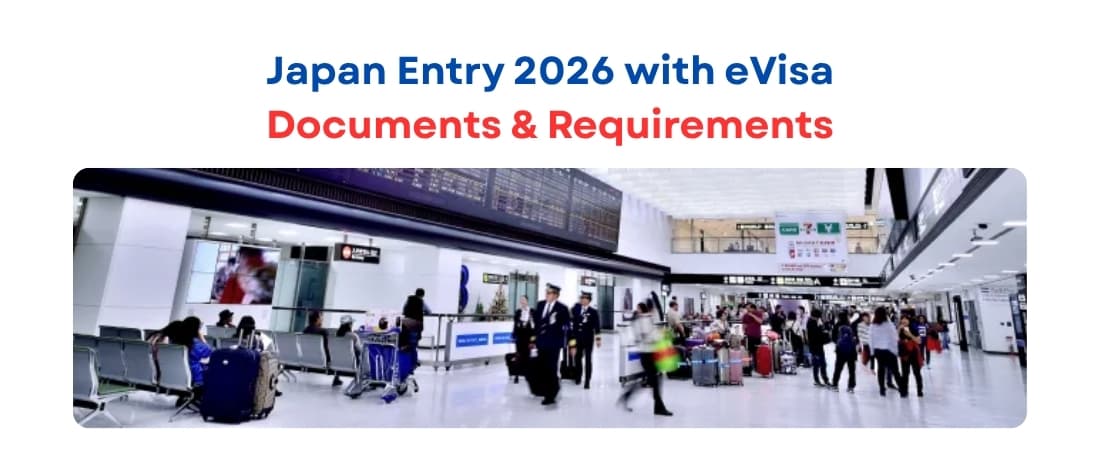
Entering Japan with an eVisa is becoming increasingly popular thanks to its simple process and fast handling time. However, to ensure smooth entry, all mandatory requirements must be clearly understood—from pre-departure preparation to airport procedures.
There have been many cases where travelers were denied boarding or held at immigration simply because of incorrect eVisa presentation, missing QR codes, or inconsistent information. This article will help you understand each requirement and how to prepare properly from the beginning.
Mandatory Requirements for Entering Japan
Visa Issuance Notice
This is the most important requirement that many people often overlook. When checking in at the airport and when passing through immigration in Japan, you must log in directly to the eVisa system via your phone browser and display the Visa Issuance Notice for staff to check.
The Visa Issuance Notice will be checked at both the check-in counter and the immigration checkpoint. It is important to note that the Japanese system does not accept PDF files, screenshots, or printed copies.
Entry QR Code
At least 6 hours before departure, you need to access the Visit Japan Web system to complete your immigration and customs declaration. After completing the process, the system will issue a QR code corresponding to your registered information.
You should save this QR code on your phone for use upon arrival in Japan. At the airport, simply scan this code at the automated kiosks to complete the process quickly, helping you save time compared to manual processing at the counter.
Original Passport
A valid original passport is required, with at least 6 months of validity from the intended date of entry. The passport presented must be the same one used during the eVisa application.
If a new passport has been issued after obtaining the eVisa, the previously issued visa becomes invalid. A new eVisa application must be completed using the current passport.
Return or Onward Ticket
A return ticket or onward ticket to another destination is required to demonstrate departure from Japan within the permitted period.
Flight details should be clear and consistent with the declared travel itinerary. In some cases, immigration officers may request verification.
Accommodation Confirmation
Accommodation details in Japan must match the Schedule of Stay declared in the eVisa application, including hotel name or residential address.
If discrepancies are identified between declared and presented information, immigration officers may request clarification or conduct additional checks.
Proof of Financial Means (if required)
In some cases, especially for first-time travelers to Japan or those with unclear financial backgrounds, you may be asked to prove your ability to cover the cost of your trip.
You should prepare bank statements for the last 3 months or documents showing your source of income to present when required. Being prepared will help the inspection process go smoothly and avoid issues at immigration.
Common Cases of Entry Refusal
Even if you already have an eVisa, you may still be denied entry into Japan if you fall into one of the following cases:
- Inconsistent information: Information on your eVisa, Visit Japan Web, and documents presented at immigration do not match
- Unclear travel purpose: No clear itinerary, no hotel bookings, or no supporting travel documents
- Vague or unconvincing itinerary: Travel plan is too simple or not consistent with your declared length of stay
- Insufficient financial proof: Unable to prove that you can cover your expenses during the trip
- Previous immigration violations: Previously denied entry, overstayed, or violated immigration rules in Japan or other countries
Entry Process with eVisa in Japan
The actual entry process is quite simple if you have prepared all required documents:
Step 1 — Check-in at the departure airport
At the check-in counter, you need to open your phone browser, log in to the Japan eVisa system, and display the Visa Issuance Notice directly for airline staff to check. Printed copies or screenshots are not accepted at this step.
Step 2 — Scan QR code at automated kiosk
When arriving at a Japanese airport, proceed to the automated kiosk area (e-Gate) and scan the QR code issued from Visit Japan Web. This step helps process your immigration and customs information quickly and reduces waiting time.
Step 3 — Immigration inspection
After completing the kiosk step, you will go to the immigration counter for direct inspection. Officers will ask you to present your passport and eVisa (displayed directly on your phone). In some cases, you may be asked about your flight tickets, accommodation, or financial situation, so be prepared with the necessary documents.
Step 4 — Receive Landing Permission stamp
If everything is valid, your passport will be stamped with a Landing Permission seal. This is the final step confirming that you are officially allowed to enter Japan.
Conclusion
Japan’s entry process in 2026 has been almost fully digitalized, making procedures faster and more convenient. However, it also requires careful preparation before arriving at the airport. As long as you understand the requirements, complete your Visit Japan Web declaration, and ensure all information and documents are consistent, you can enter Japan smoothly and successfully.
If you need support with your Japan eVisa or are unsure about your documents, contact Global eVisa for detailed consultation and fast, reliable assistance.