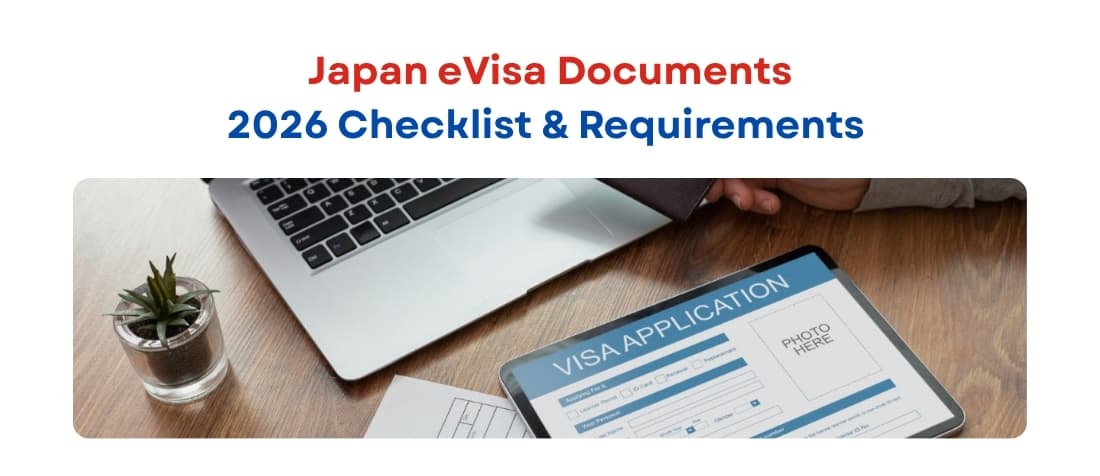
When applying for a Japan eVisa, one of the most important steps is preparing all required documents correctly. Missing a single file, using the wrong format, or submitting non-compliant images may lead to rejection or longer processing time. Depending on each case — nationality, place of residence, age, or submission method — the document requirements may vary. Follow Global eVisa’s guide below to fully understand the checklist before starting your application.
What is a Japan eVisa (Tourist Visa)?
The Japan eVisa is an electronic visa that allows travelers to apply entirely online and receive their visa in digital format — instead of having a visa sticker placed in their passport like traditional visas. The entire process, from application submission and payment to visa issuance, is handled through the official Japan eVisa system of the Ministry of Foreign Affairs of Japan, or via designated travel agencies depending on the applicant’s nationality and place of residence.
This visa is mainly issued for short-term tourism purposes of up to 90 days. The Japan eVisa is strictly for tourism purposes — other purposes such as visiting relatives, business trips, or meetings still require a traditional visa following standard procedures.
2026 Japan eVisa Checklist: Required Documents
Passport
This is the most important and mandatory document in your application. When uploading, ensure that the passport data page image is clear, well-lit, and fully shows the MRZ (Machine Readable Zone) — the two lines of machine-readable characters at the bottom of the passport page. This is the most common reason for upload errors.
Technical requirements:
-
Formats: PDF, JPG, PNG, TIF, GIF, BMP, HEIC
-
File size: recommended under 2MB
-
Resolution: at least 640×480
-
Only one page per upload field
Common upload errors to avoid:
-
Missing MRZ or MRZ is blurry, wrinkled, or covered
-
Image is tilted or upside down
-
Passport photo is not clearly visible or missing front-facing portrait
Facial Photo
The photo must be taken within the last 6 months, with a plain light background and a straight, front-facing view. The Japan eVisa system includes a built-in tool to crop and adjust the image to the standard frame, making it easier to correct during upload.
Technical requirements:
-
Formats: JPG, PNG, GIF, BMP, HEIC
-
File size: recommended under 2MB
Flight Itinerary
A document confirming your entry and exit flight details to/from Japan. This can be a booking confirmation from an airline or travel agency. In some cases, fully paid tickets are not required, but flight details must be clear and consistent with your travel plan.
Schedule of Stay
A detailed itinerary for your entire stay in Japan, including arrival and departure dates, accommodation details (hotel name or full address), and planned activities. The more detailed and consistent it is with other documents, the stronger your application will be.
Proof of Financial Ability
Documents proving that you have sufficient financial capacity to cover your trip expenses. Typically, this is a bank statement from the last 3 months. If you have a financial sponsor, you must also provide documents proving your relationship and the sponsor’s financial documents.
Proof of Immigration Status
Documents proving that you are legally residing in the country where you are applying from. This is a mandatory requirement because the Japan eVisa is assessed based on residency, not nationality. This may include a residence card, long-term visa, or equivalent documents.
Additional Documents (if required)
In some cases, additional documents may be required:
- Proof of relationship with sponsor — if someone is financially sponsoring your trip
- Sponsor’s passport or national ID — along with their financial documents
- Proof of legal residence in your current country — if not already covered above
- Parental or guardian consent letter — required for minors
- Letter of Authorization — required if applying through a third party
Important Notes for Japan eVisa Application
- You can only apply as early as 3 months before your departure date. Applications submitted earlier will not be accepted.
- Once approved, you must log into the system and present your eVisa digitally on your device at the airport. PDF files, screenshots, or printed copies are not accepted.
- If you change your passport after the eVisa has been issued, you must reapply with your new passport — the old eVisa becomes invalid.
- The eVisa is valid only for tourism purposes. If you are traveling for business, visiting relatives, attending conferences, or other purposes, you must apply for a traditional visa.
- Entry is only permitted via international flights or specific ferry routes such as Japan–Busan or Japan–Shanghai.
Conclusion
Preparing a Japan eVisa application is not difficult, but it requires attention to detail — from file formats and image quality to consistency across documents. This checklist summarizes everything you need to prepare, helping you save time and avoid unnecessary mistakes during the application process.
If you need assistance with your Japan eVisa application and are unsure where to start, Global eVisa is ready to support you — from document checking to submitting the application on your behalf, quickly and in the correct procedure.