

Preparing a visa application using the traditional method is often time-consuming and prone to errors due to manual processing procedures. The eVisa was introduced as a solution to simplify the process and allow travelers to complete most of the application steps before departure, and Thailand has also implemented this system. In this article, Global eVisa will clarify what the Thailand eVisa is, how it works, and which entry procedures can be completed online.
What is an eVisa?
A Thailand eVisa is an electronic visa issued by the Thai immigration authority through an online system, allowing foreign travelers to submit applications and receive results without visiting an Embassy or Consulate in person.
In essence, the Thailand eVisa has the same legal validity as a traditional visa. The difference lies in the process: all steps — from filling out forms, uploading documents, and making payment to receiving results — are completed online. Once approved, the visa is issued as a digital file, which can be printed or stored on a device for presentation when entering the country.
Online immigration options in Thailand
Currently, several types of visas and immigration procedures in Thailand can be completed online. The most common options are:
Tourist eVisa (TR)
The Tourist eVisa is an electronic visa for travelers entering Thailand for tourism, leisure, or visiting family and friends. It does not apply to work or business-related activities.
It typically allows a stay of up to 60 days per entry and can be extended for an additional 30 days in Thailand. The visa is generally valid for around 3 months from the date of issuance, so the timing of entry should be considered carefully.
Read more: Thailand Tourist Visa (TR) Documents Required – 2026 Checklist
Transit eVisa (TS)
The Transit eVisa (TS category) is issued for travelers who stop in Thailand while traveling to a third country.
If the traveler only transits within the airport international transit area for less than 12 hours, a Transit eVisa is not required. However, if there is a plan to pass through immigration — such as staying overnight or leaving the airport — a Transit eVisa is mandatory. The permitted stay under this category is generally up to 30 days. An onward ticket to the final destination is required as proof of transit purpose.
Non-Immigrant Business Visa (Non-B)
The Non-Immigrant Business Visa (Non-B) is intended for individuals entering Thailand for work, business, or investment purposes. It applies not only to long-term employment but also to short-term business activities such as meetings, conferences, or project execution.
This visa typically allows a stay of up to 90 days per entry and can be extended if a longer stay is required.
Digital Arrival Card (DAC)
The Digital Arrival Card (DAC) is an electronic immigration form, not a visa. It replaces the traditional paper arrival card previously used when entering Thailand. It applies to most air travelers, regardless of visa status or visa exemption eligibility.
The DAC must be completed before departure, usually within 72 hours prior to arrival. In some cases, airlines or immigration officers may request confirmation of the DAC at check-in. Failure to complete it may result in an incomplete entry requirement, even if a valid visa is held.
Should you apply for a Thailand eVisa?
If the required visa supports online application, using the eVisa system is generally recommended. Compared to the traditional paper-based process, it offers several advantages:
-
No need to visit an Embassy or Consulate
-
Ability to track application status online
-
Faster processing time for the most common visa types
-
Easy digital storage and presentation of visa documents
-
Reduced risk of documentation errors through system validation
e-Visa Professional Services at Global eVisa
In the Thailand eVisa process, selecting the correct visa type is only the first step. The key to approval lies in data consistency, proper document formatting, and strict compliance with application requirements. Even minor errors can lead to rejection and affect travel plans.
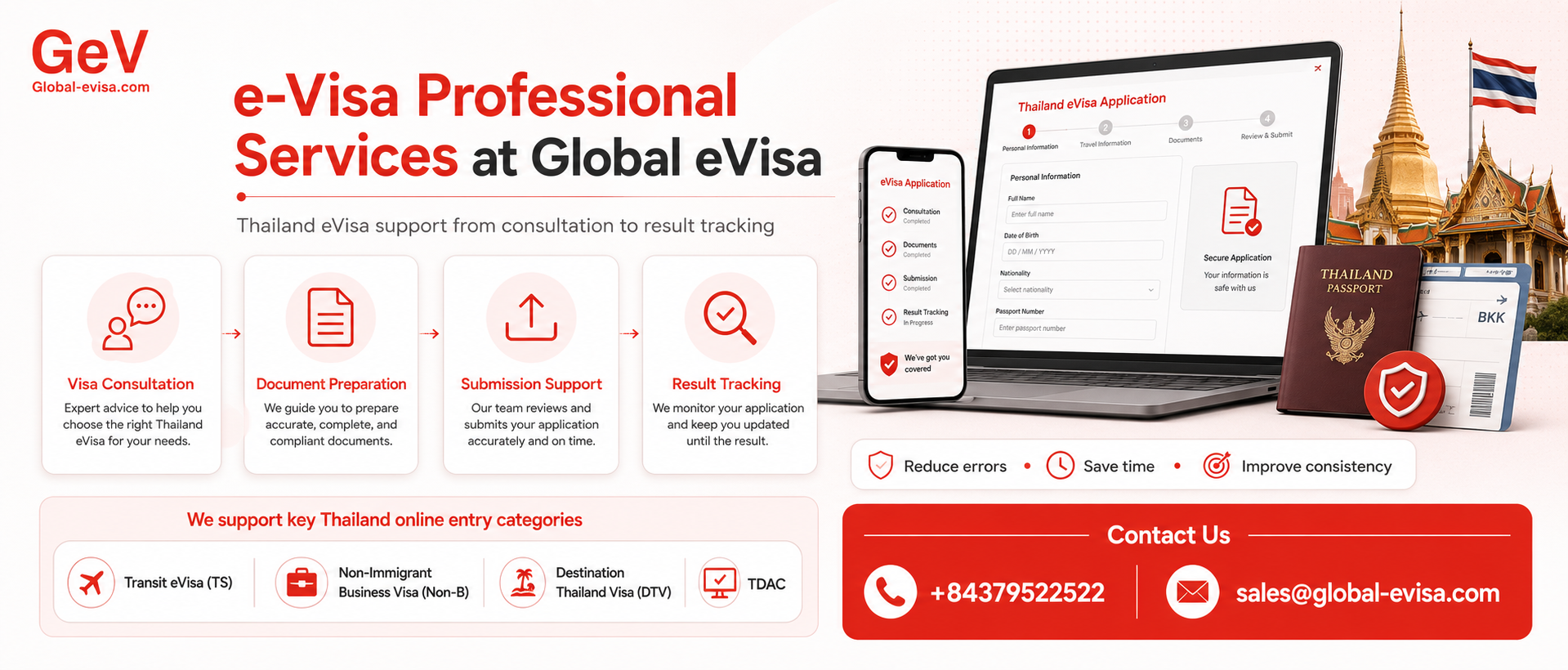
Global eVisa specializes in supporting online visa applications. With experience handling thousands of cases for both individuals and organizations, the team is familiar with Thailand’s eVisa system, including key categories such as Transit eVisa (TS), Non-Immigrant Business Visa (Non-B), Destination Thailand Visa (DTV), and Thailand Digital Arrival Card (TDAC).
Instead of handling the process alone with potential risks, clients can rely on Global eVisa for end-to-end online support, from visa consultation and document preparation to submission and result tracking, helping save time and reduce errors.
Conclusion
The eVisa system is becoming increasingly common in global immigration processes, including Thailand. Understanding each Thailand eVisa and choosing the right one from the beginning helps ensure a smoother application process and avoids unnecessary risks.
If you are unsure which visa type is appropriate, Global eVisa can provide tailored consultation and support the entire online application process based on your travel purpose.


