

In 2026, Georgia continues to be an attractive destination for travelers thanks to its relatively flexible entry policy, diverse landscapes, and convenient location between Europe and Asia. However, before the trip, travelers still need to carefully check whether they are eligible for visa exemption, qualify for an eVisa, or need to prepare another type of visa. This article from Global-eVisa.com summarizes important information about Georgia’s visa policy, entry documents, and key notes to know before traveling.
What Should You Note About Georgia Visa Policy 2026?
Georgia’s visa policy is based on each traveler’s nationality, purpose of entry, and length of stay. This means that not everyone needs to apply for a visa before arriving in Georgia. Some nationalities may be eligible for visa exemption for a certain period of time, while others need to apply for a visa or eVisa before departure.
For eligible nationalities, the Georgia eVisa is a convenient option because the application process is completed online. Applicants can fill in their information, upload the required documents, and receive the result by email after the application has been processed. This format helps save time, especially for travelers who do not live near a consular office or want to prepare their application remotely.
In addition to visa requirements, travelers should also pay attention to the documents that must be presented at the border checkpoint. Having an approved eVisa does not mean that you can enter without supporting documents. Border control authorities may ask you to prove the purpose of your trip, accommodation details, financial capacity, and valid insurance.
Visa Exemption and Conditions by Nationality
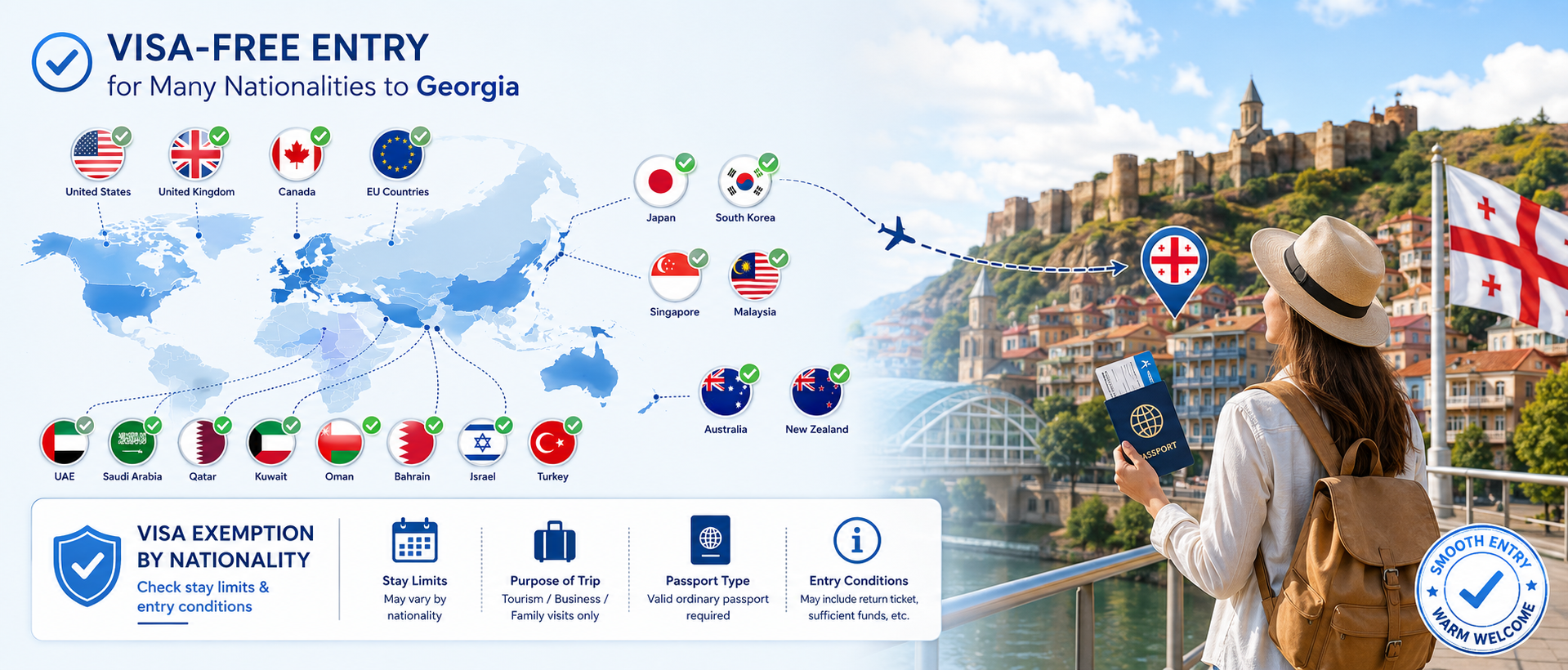
One of the reasons Georgia’s entry policy attracts the attention of many travelers is its visa exemption scheme for certain nationalities. This allows many people to travel to Georgia without applying for a visa in advance, provided that they meet the permitted length of stay and purpose of entry under the regulations.
Some countries that are commonly included in the Georgia visa exemption list include: United States, United Kingdom, Canada, Australia, New Zealand, Japan, South Korea, Singapore, Malaysia, United Arab Emirates, Saudi Arabia, Qatar, Kuwait, Oman, Bahrain, Israel, Turkey, and European Union countries.
To check the most detailed and up-to-date list of visa-exempt countries, travelers can check directly here: Do I Need Visa.
Note: Visa exemption policies may change over time and may include conditions related to length of stay, passport type, or purpose of entry. Therefore, before booking flights or departing, travelers should recheck the information according to their exact nationality and the passport they are using.
Long-Term Tourist Visa and Flexible Stay Needs
In addition to the Georgia eVisa for short-term trips, some travelers may be interested in a tourist visa option with a longer permitted stay. For those who want to explore Georgia at a slower pace, spend more time in different regions, or return multiple times within the visa validity period, the Tourism Up to 1 Year Visa is a noteworthy option.
This type of visa is intended for tourism purposes. Travelers can use it for activities such as sightseeing, holidays, cultural experiences, culinary exploration, nature travel, or personal journeys in Georgia. If the purpose of the trip is work, long-term study, residence, or an activity that requires a separate permit, you should check another suitable visa type instead of using a tourist visa.
The Tourism Up to 1 Year Visa may allow a maximum stay of 365 days within the validity period of the eVisa. The visa may be valid for up to 5 years and allow multiple entries. This is a convenient feature for those who want to return to Georgia multiple times or combine Georgia with neighboring countries.
To choose correctly between a short-term eVisa and a long-term tourist visa, you should clearly determine three factors: the purpose of your trip, the number of days you plan to stay in Georgia, and whether you need single or multiple entries. If you are only taking a short holiday, the Georgia eVisa may already be suitable. If you want to stay longer or return multiple times, the long-term tourism option may be more worth considering.
Approved Points of Entry in Georgia
The Georgia eVisa application does not require travelers to declare their intended point of entry during the online application process. However, before departure, you should still carefully check your route to ensure that you enter through a suitable airport, land border checkpoint, or seaport.
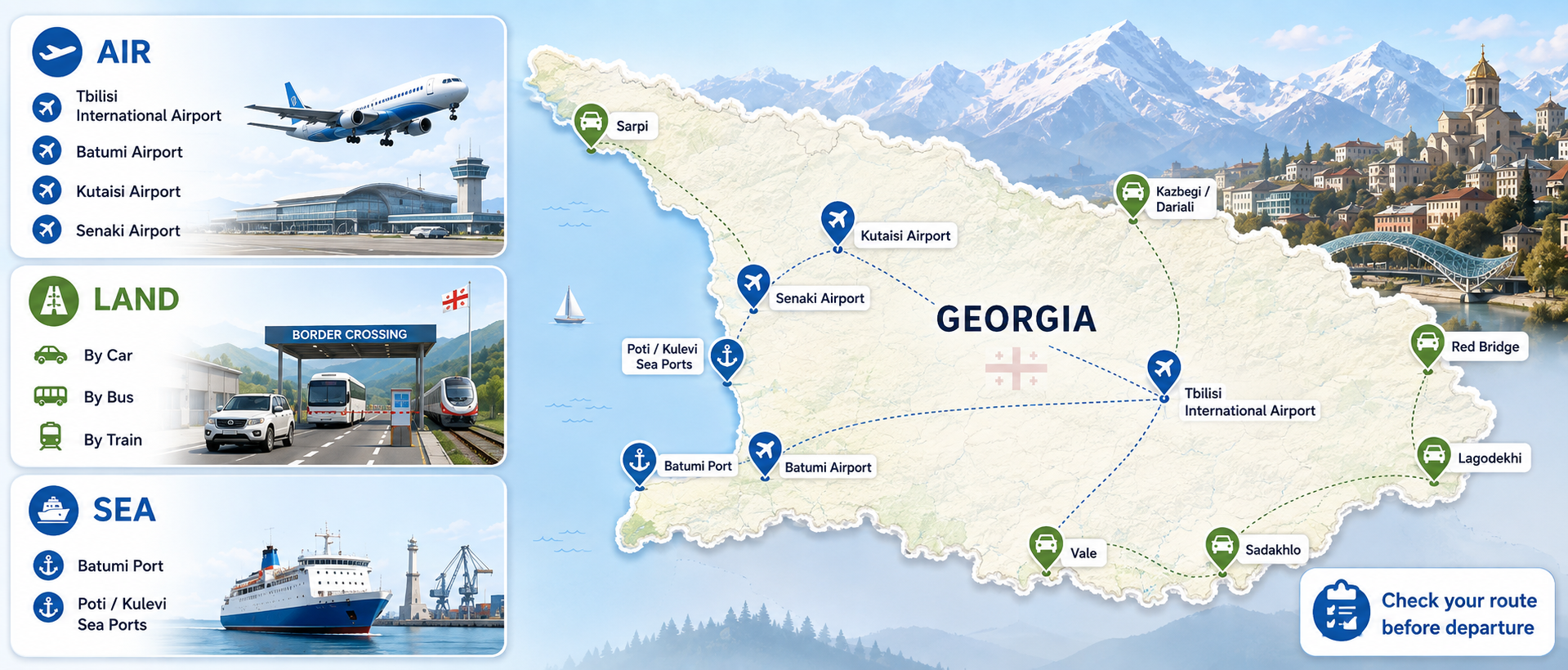
For air travel, the listed airports include Tbilisi International Airport, Batumi Airport, Kutaisi Airport, and Senaki Airport. Tbilisi is the most popular gateway for many international travelers, while Batumi and Kutaisi are suitable for itineraries to western Georgia or the Black Sea region.
For land travel, the mentioned border checkpoints include Sarpi, Kazbegi/Dariali, Kartsakhi/Kartsakhi-Akhalkalaki, Ninotsminda, Vale, Lagodekhi, Samtatskaro, Guguti, Akhkerpi, Sadakhlo by road and rail, Red Bridge, Mtkvari, and Gardabani. If you are traveling by coach, private rental car, or train, carefully check the actual border checkpoint in your itinerary.
For sea travel, the points of entry include Batumi Port and Poti Port/Kulevi Sea Ports. This is a suitable option for certain transport routes or special itineraries in the region.
Regulations on points of entry may change without prior notice. Therefore, travelers should verify the information again with the airline, transport provider, travel agency, or official information source before the travel date. This is especially important if you travel by land or sea, as border checkpoints may change their operating hours or acceptance conditions.
Global-evisa.com Supports Georgia Visa Applications
Global-evisa.com helps travelers learn about and apply for the Georgia eVisa in a clearer, more convenient, and easier-to-use way. For those preparing an application for the first time, identifying the correct visa type, checking passport requirements, preparing photos, insurance, and entry documents can take a lot of time.
Through the Global-evisa.com system, users can fill in application information, upload the required documents, check the fees, and complete the application online. The steps are presented clearly so travelers can follow them easily, reduce mistakes, and be more proactive during the preparation process.
The support service is also useful if you are not sure whether you are eligible for visa exemption, qualify for an eVisa, or should choose another type of visa. Depending on your nationality, purpose of travel, and length of stay, Global-eVisa can help you check the information and prepare a more suitable application before departure.
Conclusion
Georgia’s visa policy in 2026 requires travelers to carefully check the conditions based on nationality, purpose of entry, and length of stay before departure. Whether you are visa-exempt, applying for a Georgia eVisa, or need a long-term tourist visa, preparing your passport, photo, insurance, and supporting documents at the border checkpoint remains very important. If you need assistance with applying for a Georgia visa or checking the suitable visa type, contact Global-evisa.com today for quick and clear consultation.


