

As international entry procedures become increasingly digitalized, the Vietnam eVisa has become one of the visa options commonly chosen by travelers and business visitors planning to enter Vietnam. Instead of submitting documents directly at an Embassy or Consulate, foreign nationals can complete the visa application process online and receive the result in electronic format.
In this article, Global eVisa will explain what a Vietnam eVisa is and clarify how it differs from Visa on Arrival and the traditional visa.
Common Types of Visas in Vietnam
What is a Vietnam eVisa?
A Vietnam eVisa, or Electronic Visa, is an electronic visa issued to foreign nationals by the Vietnam Immigration Department through an online system. With this visa type, applicants can submit their application online without visiting an Embassy or Consulate, without sending their original passport, and receive the result as an electronic file once the application is approved.
Today, the eVisa is one of the most convenient Vietnam visa options for tourists, short-term business visitors, and foreign nationals who need to stay in Vietnam temporarily. A Vietnam eVisa is valid for up to 90 days and supports both single entry and multiple entry, giving travelers more flexibility when planning their itinerary.
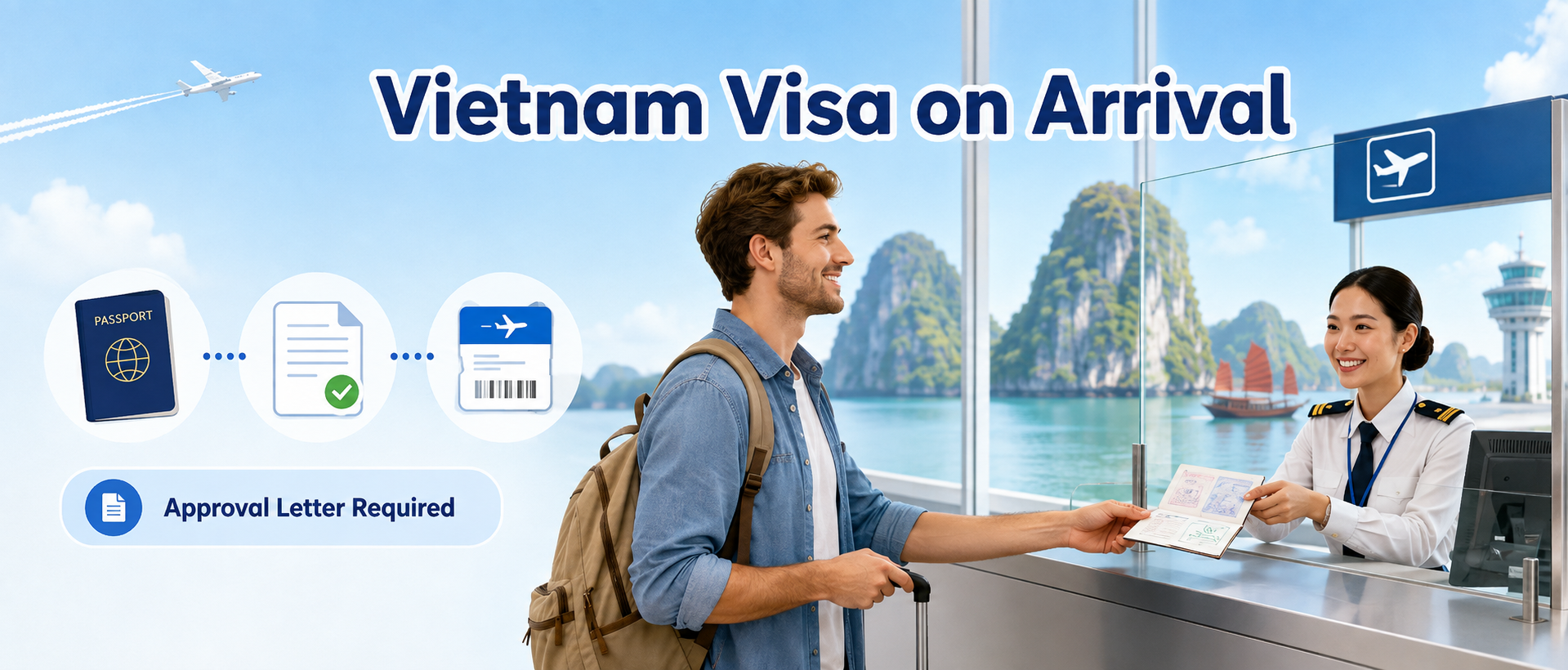
What is Vietnam Visa on Arrival?
Visa on Arrival (VOA) is a visa option that allows foreign nationals to receive their visa upon arrival at an international airport or border checkpoint in Vietnam. However, unlike some countries where travelers can apply for a visa directly at the destination, Vietnam Visa on Arrival usually requires an approval letter before departure.
The approval letter is typically arranged before the trip through a visa support provider, a sponsoring company, or an organization in Vietnam. Therefore, Visa on Arrival is generally suitable for cases that require sponsorship, a separate entry approval letter, or applications that are not convenient to process through the standard eVisa route.
What is a Traditional Vietnam Visa?
A traditional visa is a visa obtained through a Vietnamese Embassy or Consulate abroad. With this option, applicants usually need to prepare the required documents according to the instructions of the relevant diplomatic mission, then submit the application directly or through the method specified in each country.
Compared with an eVisa, a traditional visa often requires more preparation steps and may take longer to process. However, it remains necessary in certain specific cases, such as complex applications, entry purposes that are not suitable for an eVisa, or visa types that need to be processed through a diplomatic mission.
Comparison of Vietnam eVisa, Visa on Arrival, and Traditional Visa
To better understand the differences between eVisa, Visa on Arrival, and traditional visa, you can refer to the overview table below:
|
Criteria |
Vietnam eVisa |
Visa on Arrival |
Traditional Visa |
|
Application method |
Apply online |
Requires an approval letter in advance |
Apply through an Embassy/Consulate |
|
How the visa is received |
Receive an electronic file |
Receive a visa sticker upon arrival in Vietnam |
Receive according to the diplomatic mission’s procedure |
|
Validity |
Up to 90 days |
Based on the approval letter |
Depends on the visa type |
|
Number of entries |
Single or Multiple |
Based on the approved visa type |
Depends on the visa type |
|
Best suited for |
Tourism, short-term business trips |
Applications requiring sponsorship or a separate approval letter |
Special cases, long-term visas |
What Are the Requirements for a Vietnam eVisa?
Before applying for a Vietnam eVisa, applicants need to prepare their personal information, passport details, and travel information. In general, the application requires:
-
A valid passport, preferably with at least 6 months of validity from the intended date of entry.
-
A clear portrait photo that meets the requirements of the Vietnam eVisa system.
-
A photo or scanned copy of the passport information page.
-
Intended entry and exit dates.
-
Entry and exit checkpoints included in the approved list.
-
Accommodation address in Vietnam, such as a hotel or intended place of stay.
-
An email address to receive application updates and the eVisa result.
-
A valid online payment method.
-
The applicant must not fall under any category prohibited from entering Vietnam.
Common Types of Vietnam eVisas
Depending on the purpose of travel, length of stay, and number of entries required, foreign nationals can choose the eVisa type that best fits their itinerary. In the reference service table, Vietnam eVisas are commonly categorized by travel purpose, validity period, and number of entries.
|
eVisa Type |
Validity |
Number of Entries |
Best Suited For |
|
eVisa Tourist 1 month Single |
1 month |
Single entry |
Short-term tourism |
|
eVisa Tourist 1 month Multiple |
1 month |
Multiple entry |
Tourism combined with trips to multiple countries |
|
eVisa Tourist 3 months Single |
3 months |
Single entry |
Longer stay with only one entry into Vietnam |
|
eVisa Tourist 3 months Multiple |
3 months |
Multiple entry |
Travelers who need to enter and exit Vietnam multiple times |
|
eVisa Business 1 month Single |
1 month |
Single entry |
Short-term business trips |
|
eVisa Business 1 month Multiple |
1 month |
Multiple entry |
Short-term business trips with multiple movements |
|
eVisa Business 3 months Single |
3 months |
Single entry |
Longer business trips |
|
eVisa Business 3 months Multiple |
3 months |
Multiple entry |
Business owners, executives, or professionals who need flexible entry |
Vietnam eVisa Fees
The cost of applying for a Vietnam eVisa usually includes the government fee and a service fee if the applicant uses a visa support provider. According to the official eVisa portal, the eVisa fee is USD 25 for single-entry visas and USD 50 for multiple-entry visas.
When using Global eVisa’s support service, the total cost may also include document checking, application assistance, expedited processing, and result tracking. The table below shows reference fees based on visa type and processing time:
|
Visa Type |
Processing Time |
Government Fee |
Service Fee |
Estimated Total |
|
eVisa Tourist 1 month Single |
4 days |
USD 35 |
USD 44 |
USD 79 |
|
eVisa Tourist 1 month Multiple |
4 days |
USD 60 |
USD 49 |
USD 109 |
|
eVisa Tourist 3 months Single |
4 days |
USD 35 |
USD 54 |
USD 89 |
|
eVisa Tourist 3 months Multiple |
4 days |
USD 60 |
USD 59 |
USD 119 |
|
eVisa Business 1 month Single |
4 days |
USD 35 |
USD 44 |
USD 79 |
|
eVisa Business 1 month Multiple |
4 days |
USD 60 |
USD 49 |
USD 109 |
|
eVisa Business 3 months Single |
4 days |
USD 35 |
USD 54 |
USD 89 |
|
eVisa Business 3 months Multiple |
4 days |
USD 60 |
USD 59 |
USD 119 |
The fees above are for reference only and may vary depending on visa type, nationality, processing time, application date, and the actual service policy at the time of application.
Conclusion
A Vietnam eVisa is an electronic visa that allows foreign nationals to enter Vietnam more conveniently through an online application process. With a validity of up to 90 days, support for both single and multiple entries, and availability for citizens of all countries and territories, the eVisa is now a suitable option for most tourism and short-term business travel needs in Vietnam.
If you are planning to apply for a Vietnam eVisa but are not sure where to start, Global eVisa can help you choose the right visa type, review your documents, and process your application efficiently based on your travel needs.